- Home
- Evangelism Outreach History
- Evangelism Outreach Reports
- Way of the Master Week 4
Way of the
Master Week 4: What Did Jesus Do (WDJD)?
2005 Archive: Learning the WDJD Strategy
By Brad St. Clair, Evangelism Coach

If Way of the Master Week 3 turned on the spotlight, then Way of the Master Week 4 handed us the map—showing the path Jesus walked and how we can follow in His steps.
We stopped just looking in the mirror and started learning how to move—following the exact footprints Jesus left for us.
You could feel the hunger in the room. Even with choir practice calling some away, many people leaned in close to see the "WDJD" (What Did Jesus Do) strategy in action.
This wasn't just another lecture; it was the moment our training got hands-on.
We moved past the "fluff" and got down to the heart of the matter: learning the simple, biblical way Jesus started conversations that changed lives forever.
Let’s rewind the church calendar to 2005 and step into a Wednesday night where Way of the Master filled the room, notebooks were open, and WDJD was taking shape.
September 7, 2005: A Packed House and a Pastoral Charge
During Way of the Master Week 4, we played the "WDJD - What DID Jesus Do" video. It was a powerful night!
Choir practice started at the same time as the class, taking about 25-30 people, but we still had 89 believers there.
Before I went up to teach, Pastor Mark Shorey said he wanted to talk a little. He said that it is every Christian's responsibility to preach the Word and witness to others.
It is not only for pastors and church staff. He said if we can get a group to go out and street witness, we will win this city to Christ.
We will be going out as a church group to witness on Saturday, September 17, 2005 in downtown Branson, MO.

Leann, my wife, went over the Ten Commandments memorization page with everyone, one by one.
We had lots of compliments about showing them how to memorize the Ten Commandments.
There is a little picture beside each commandment that will keep you from ever forgetting them. It will even help you remember the correct order in which they go.
I read a letter from a Christian I know who lives in Australia. He was recently attacked while open air preaching. Their laws are different. We have freedom of speech here in America.
I mentioned that the worst thing that is likely to happen to us is that we will be told, "I don't want that gospel tract" or "I don't want to talk" when they are trying to do one-to-one witnessing.
If a Christian can put up with being attacked and keep preaching, then we can put up with a "No thanks" from someone.
The WDJD Blueprint: A Biblical Witnessing Encounter
As we continued Way of the Master Week 4, the WDJD video walked us through the process step-by-step , and suddenly faces shifted—from "I could never do that" to 'wait, I can actually do this.'"
Everyone is beginning to understand how important it is to use the Law, the Ten Commandments, when witnessing to someone.
Here is an easy to remember guide — an acronym starting and leading someone through a witnessing encounter.
W.D.J.D. - What Did Jesus Do (See John 4:7-26) Start a conversation in the natural and swing it to the spiritual.
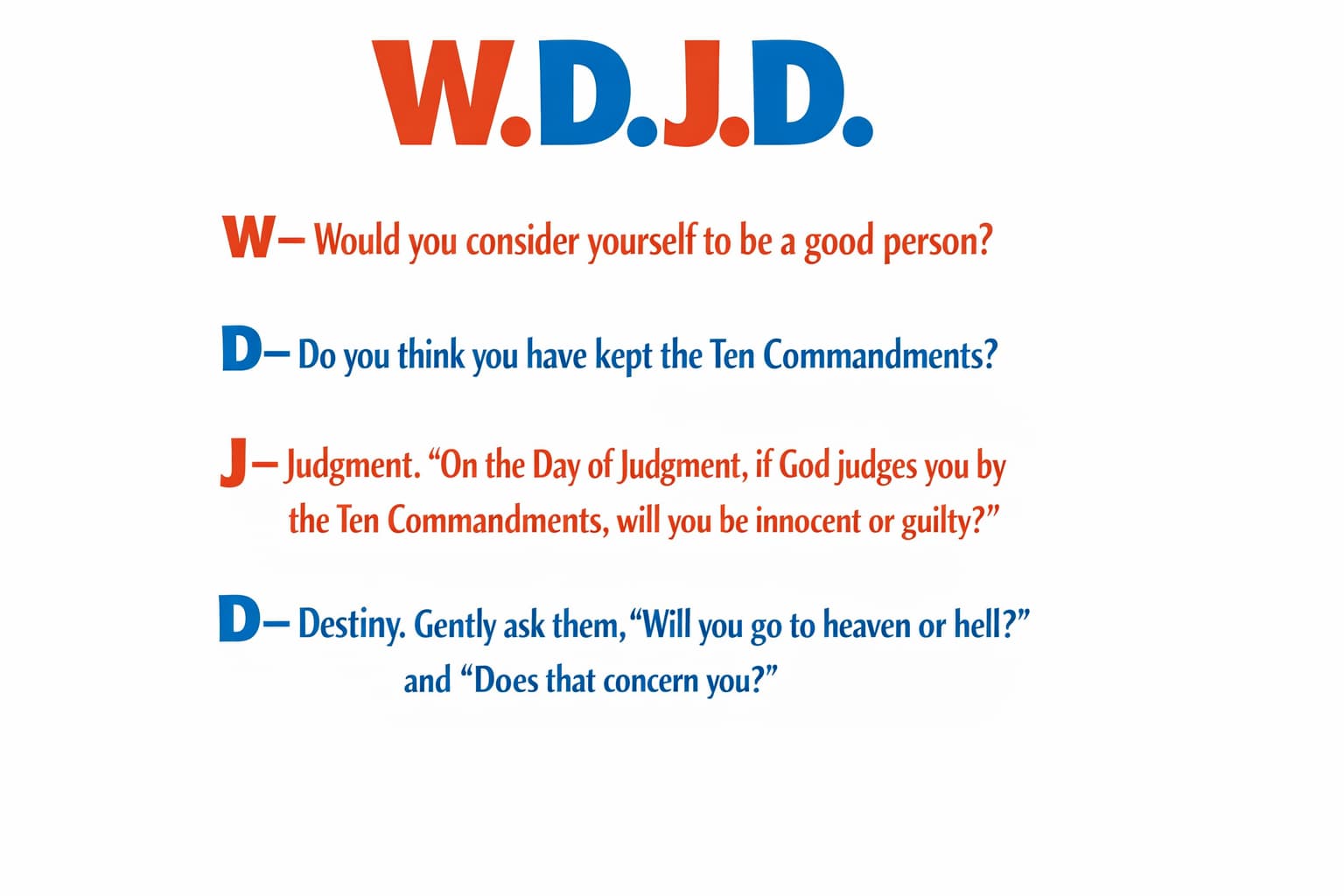
Ask someone:
W – Witnessing Kickoff: The Good Person Test
W – "Would you consider yourself to be a good person?"
D – Divine Standard: The Ten Commandments
D – "Do you think you have kept the Ten Commandments?”
Most everyone believes that some amount of good works is enough to get them into heaven.
Let's ask a few questions to see if God will consider you "good enough" to go to heaven. Be honest with yourself and before God as you answer these questions.
Have You Ever Told a Lie?
The Ninth of the Ten Commandments is "You shall not lie" (Exodus 20:16).
Telling just one lie, according to God's standards, makes you a "liar." In Revelation 21:8, God says, all liars shall have their part in the lake of fire.
Have You Ever Stolen Anything?
The Eighth of the Ten Commandments is "You shall not steal" (Exodus 20:15).
Stealing just one thing — regardless of its size or monetary value — according to God's standards, makes you a thief. In 1 Corinthians 6:10, God says, no thief will inherit the kingdom of God.
Have You Ever Looked With Lust?
The Seventh of the Ten Commandments is "You shall not commit adultery" (Exodus 20:14).
If you've ever looked at another person with lustful thoughts, according to God's standards, that makes you an "adulterer."
In Matthew 5:28, Jesus replied, you have heard it said you shall not commit adultery. But I say to you that whoever looks on a woman with lust has already committed adultery with her in his heart.
In 1 Corinthians 6:9-10, God says that no adulterers shall inherit the kingdom of God.
Have You Ever Used God’s Name in Vain?
To include Jesus or Christ as a curse word — one example is "Oh my G-d!"
The Third of the Ten Commandments is "You shall not take the name of the Lord in vain" (Exodus 20:7).
If you've ever used the name God in vain, or as a curse word, what you've done is take the name of the God who gave you life, and you've used it as if it were a four-letter filth word to express disgust.
That offense is called "blasphemy," and according to God's standards, you are a "blasphemer." In Leviticus 24:16, God says, he that blasphemes the name of the LORD must be put to death.
That was only four of the 10 Commandments that we’ve gone through. There are still six more. Let me ask you a question.

Brad St. Clair is an evangelist and evangelism coach, and the founder of YouEvangelized — formerly Repent and Turn Ministries — with 22 years of hands-on ministry experience. He's an independent ordained minister with an Associate of Ministry Degree and a Diploma of Biblical Studies. Brad has trained hundreds of believers, led public-outreach sessions, and open-air preached to crowds. His ministry is documented at YouEvangelized. When he's not training others, Brad often turns motorcycle rides into opportunities for prayer and gospel conversations.
Now, let’s finish the WDJD blueprint with the final two steps of the encounter:
J – Judgment Day: Innocent or Guilty?
J – "On the Day of Judgment, if God judges you by the Ten Commandments, will you be innocent or guilty?"
D – Destiny: Heaven or Hell?
D – Destiny. Gently ask them, “Will you go to heaven or hell?" and "Does that concern you?"
Listen to their answers. If they are concerned and appear to be convicted of their sin, follow the leading of the Holy Spirit.
Remind them that we broke God's law but Jesus paid our fine.
You may be led to share more salvation-related Bible verses and lead them in a prayer.
Doors Opening and Hearts Stirring
There was a lady from another church there tonight. She wanted to know how to get this info to her pastor. I gave her my card and the Way of the Master website address.
She said that her pastor may be calling me to discuss this evangelism training with him.
The Enduring Takeaway and Call to Action: Your Turn
You’re not calling anyone a sinner—the Ten Commandments simply hold up the mirror and let them see it for themselves.
If you are still nervous about getting started witnessing to others, remember this:
If a Christian in Australia can keep preaching the Gospel after getting attacked, we can definitely handle someone saying "no thanks" without crying about it. 😉
Your Mission: Trying the "Good Person Test" This Week
Call to Action:
Stop waiting for a "perfect" moment. If you want to learn how to share your faith effectively, just start a sincere conversation using the "Would you consider yourself a good person?" hook.
You have the Gospel in your hands—now get off the sidelines and into the game.
In other words, don’t be like I was when I first started this. I sat around and memorized this stuff and delayed using it with real people.
Instead, get out there and try the "Good Person Test" on a friend this week. The worst they can say is they don’t want to answer the questions.
This week, find one friend and ask if they'll take the "Good Person Test" with you. They might say no. They might say yes.
Either way, you're not stuck on the sidelines anymore. Worst case? They say no thanks. Best case? You just opened a door.
Subscribe below to stay connected with our community and receive unshakable truths for your next rescue mission - two times a month.
Common Questions in Way of the Master Week 4: What Did Jesus Do (WDJD)?

Why does this method walk through several different commandments instead of just one?
Why does this method walk through several different commandments instead of just one?
Good question — it'd be a lot quicker to just ask about one. But one commandment can feel like an easy pass. Someone might say, "I've never murdered anyone," and stop listening right there.
Walking through a few — lying, stealing, lust, blasphemy — closes that exit early. It's harder to argue your way out of all of them.
It's not about piling on guilt. It's about being thorough enough that the point actually lands: nobody is "good enough" on their own, no matter which door they try to slip through.
Isn't the "Good Person Test" a little manipulative or guilt-trippy?
Isn't the "Good Person Test" a little manipulative or guilt-trippy?
I get why it can feel that way from the outside. Nobody enjoys being told they've broken God's Law, including me the first time I heard it explained.
But here's the thing — it's not a trick question. It's an honest one. If someone's already told a lie, stolen something, or looked at someone with lust, pointing that out isn't manipulation.
It's just naming what's already true. The goal isn't to trap anyone. It's to help them see clearly, one time, before it matters most. Once they see and understand their sin, that's when they understand they need forgiveness of their sins.
Someone says lying and stealing aren't "that bad" compared to real crimes. How do I respond?
Someone says lying and stealing aren't "that bad" compared to real crimes. How do I respond?
That's a fair question, and I've heard people say it. The point isn't comparing sins to each other — it's comparing them to God's perfect standard, not some other person's worse behavior. We're not grading sins on a curve.
By human standards, sure, a white lie feels small next to a robbery. But God's standard isn't "better than average." It's perfect. One lie is enough to make someone a liar by that measure, the same way one hole sinks a boat no matter how small it is.
How do I turn a normal conversation into a spiritual one without it feeling forced?
How do I turn a normal conversation into a spiritual one without it feeling forced?
It rarely feels smooth the first number of times you do it. It didn't for me either. But it does get easier the more times you practice turning a natural conversation to a spiritual conversation.
The trick is starting with something ordinary — saying hi, the weather, small talk, whatever's already happening — and then asking one simple question that opens the door, like "Do you ever think about spiritual things?"
You're not hijacking the conversation. You're just adding a lane to a road that's already there. If they don't want to go down it, that's fine. If they do, you're ready.
What if someone gets offended or says "no thanks"?
What if someone gets offended or says "no thanks"?
Then they said no thanks. That's it. If you live in America, that's most likely the whole worst-case scenario. Tell them thanks and that it was nice speaking with them. End on friendly terms if you can.
I mentioned a believer in Australia who kept preaching after getting physically attacked for it. Compared to that, a stranger declining a conversation is something we can survive just fine.
Rejection stings for a second. It doesn't actually cost you anything.
What if I'm not just nervous about rejection, but worried about my safety when sharing my faith in public?
What if I'm not just nervous about rejection, but worried about my safety when sharing my faith in public?
That is a fair concern, and I've had it myself. Not every country protects free speech like ours (America) does.
That Australian believer who got attacked while preaching didn't have the same legal protection we have here.
In most everyday settings in America, the real risk is small — someone declining a conversation, not physical harm.
That said, use common sense: go out at least in twos to witness when you can, especially somewhere unfamiliar, and trust your gut if a situation feels off.
Wisdom and courage aren't opposites. You're allowed to have both. Be safe.
Is this Way of the Master class still taking place at Tri-Lakes Church?
Is this Way of the Master class still taking place at Tri-Lakes Church?
This page covers week four of our 8-week course back in September 2005 — the church isn't there anymore, so it's not a live class you can walk into today.
The WDJD evangelism method taught that night still works exactly the same now as it did then. Want to see how the whole course worked for us? You can follow all 8 weeks right here on the site.
Look on this page below and click on on the week you want to read about.
← Previously: The Mirror of the Ten Commandments— Week 3 | Next Up: Gospel Tracts as Ice Breakers — Week 5
Walk through the full training—from the first 'hello' to the boldest street encounter. Follow our journey week by week:
Week 1 — Week 2 — Week 3 — Week 4
Week 5 — Week 6 — Week 7 — Week 8
- Home
- Evangelism Outreach History
- Evangelism Outreach Reports
- Way of the Master Week 4
What to say. When to say it.
How to not chicken out.
Recent Articles


-
Christian Integrity at Work Examples for Evangelism
Oct 07, 26 06:20 AM
 How does Christian integrity at work show up? See real quotes, Scripture, and simple ways to earn trust with coworkers before you speak about Jesus.
 -
YouEvangelized Evangelism Training — Ministry Testimonials
Sep 25, 26 11:04 AM
 Want to share your faith without freezing up? See real stories from pastors and everyday believers who went through Brad St. Clair's evangelism training.
 -
Contact Brad St. Clair | YouEvangelized
Sep 17, 26 10:24 PM
 Have a question about evangelism or need some encouragement? Reach out to Brad St. Clair, founder of YouEvangelized. He'd love to hear from you.